
Imagine a giant.
Not an ordinary giant, but one blessed with everything a nation could ask for. Vast lands. Endless resources. Brilliant minds. Rich culture. Boundless energy.
For sixty-six years, this giant has walked the earth.
Or at least, that is what the world assumes.
But one day, you look closer and discover something strange.
The giant is not walking at all.
He is standing behind invisible chains.
The chains are not obvious. They are not made of iron. They cannot be seen from satellite images or measured by economists. Yet they are there, wrapped around the lives of millions of citizens every single day.
Nigeria’s sixty-sixth birthday forces us to confront a difficult question:

What are the invisible chains holding our giant down?
Most people point immediately to electricity, inflation, unemployment, and corruption. Those are real problems. They are visible problems.
But some of the deepest wounds are the ones we hardly discuss.
The wounds that quietly diminish dignity.
The wounds that steal freedom.
The wounds that make survival feel like an achievement.
Consider a young professional in Lagos.
It is 2:00 a.m.
Her phone rings.
A family member in Finland has suffered a medical emergency.
She needs to travel immediately.
In many countries, this story is simple. Within hours she would be on a plane heading toward her destination.
But she is Nigerian.
Suddenly, geography no longer matters.
What matters is paperwork.
Permissions.
Appointments.
Screening.
Interviews.
Approvals.
The clock begins to move faster than the bureaucracy.
And in that moment she realizes something deeply uncomfortable:
She lives in a nation of more than two hundred million people, yet she does not possess the freedom of movement many citizens around the world take for granted.
A passport should be a key.
For too many Nigerians, it feels like a barrier.
And so the giant remains chained.
But there is another chain.
Across the country, thousands of young people sit in rooms filled with ambition.
Some have ideas that could create jobs.
Some have designs that could transform industries.
Some have technologies that could improve lives.
Yet many never take the leap.
Not because they lack courage.
Not because they lack intelligence.
But because the consequences of failure are simply too devastating.
In thriving societies, ambition is cushioned by institutions.
Healthcare protects families.
Credit systems support entrepreneurs.
Regulations remain relatively stable.
Support structures reduce the cost of failure.
But in Nigeria, every risk often feels like a jump across a canyon.
One illness.
One policy shift.
One economic shock.
One emergency.
And years of effort disappear.
We often praise the resilience of Nigerian youth.
Yet resilience should not be mistaken for policy.
A nation should not force its brightest minds to become survival experts before they become innovators.
And so the giant remains chained.
Then there is the final chain.
A nation separated from itself.
Every October, we celebrate our landscapes, our festivals, our ancient history, and our cultural diversity.
We speak proudly about tourism potential.
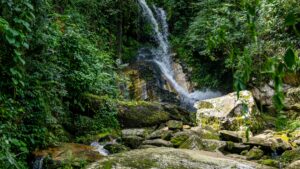
We highlight waterfalls, mountains, sacred groves, historic cities, and breathtaking landmarks.
Yet a painful question remains:
How many Nigerians can confidently explore their own country without anxiety?
Tourism is not a slogan.
Tourism begins where security starts.
It begins when families can travel without fear.
When roads become corridors of opportunity rather than corridors of uncertainty.
When adventure does not require prayer as a safety strategy.
When citizens can discover their country before foreigners do.
Until then, much of our tourism conversation remains an aspiration rather than a reality.
And so the giant remains chained.
At sixty-six years old, Nigeria should be entering an age of confidence.
An age of mobility.
An age of opportunity.
An age of institutional maturity.
Instead, millions continue to navigate invisible barriers that should have been dismantled decades ago.
Yet this story is not entirely tragic.
Because despite the chains, the giant is still standing.
Its people continue to create.
Continue to innovate.
Continue to build.
Continue to dream.
Perhaps that is Nigeria’s greatest miracle.
Not that the nation has succeeded.
But that its people have continued moving forward despite every reason to stand still.
Happy Birthday, Nigeria.
May this be the decade we stop decorating the chains and finally begin breaking them.
Leave a Reply